The Apartment Potty Routine When the Elevator Is in the Way
Measure your building's round trip in minutes before you build a schedule. Why predictability beats frequency, and how to make a trip 30 seconds of prep.
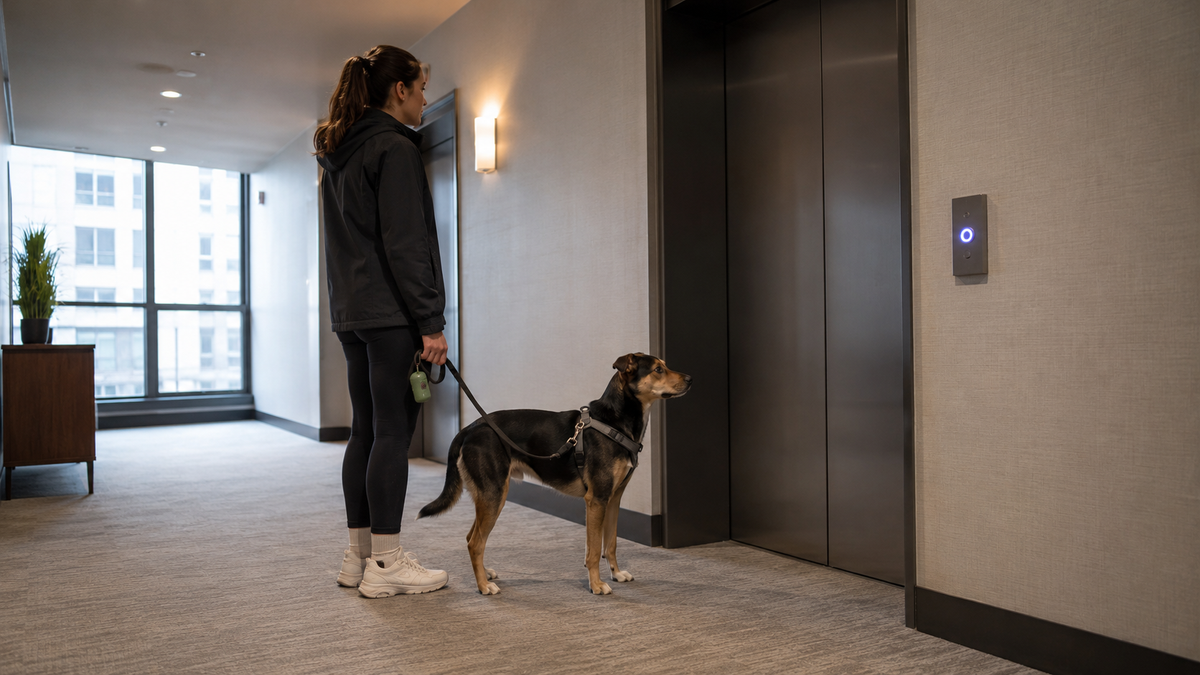
Before you build a schedule, measure your own building's round trip once: leash on, corridor, lift, lobby, street, and back. In a house this is a five-second door. In an apartment it is commonly ten minutes, and it is that number, not your dog, that decides whether a routine is sustainable on a working day. The other apartment-specific lever is predictability rather than frequency, because a dog that cannot anticipate its next opportunity is the one that struggles.
This page is about logistics. How to house-train a dog, and how to interpret accidents as a behavioural matter, belong with a qualified trainer or a veterinarian, and are not covered here.
What the elevator actually costs you
Break the trip into its parts and time them once, at a realistic hour:
| Stage | Typical variability |
|---|---|
| Getting ready inside the flat | 30 seconds to 5 minutes, depending entirely on your setup |
| Corridor to the lift | Fixed |
| Waiting for the lift | The variable that ruins schedules, worst at peak hours |
| Descent and lobby | Fixed, longer if you must use a service lift |
| Reaching an acceptable spot outside | 0 to several minutes depending on the building |
| The return | Usually faster, and still not instant |
Two things fall out of doing this once. You learn your real number, which is almost always longer than you assumed. And you find which stage is the variable one, which is where the fixing happens.
Reported observation in this area is that elevators and stairwells add latency to every break, and that where a dog cannot predict its next opportunity, particularly with lift delays in a high-rise, stress and indoor accidents follow. So the latency is not merely inconvenient. It is the mechanism.
How many trips, and where those numbers come from
Commonly published training guidance, offered as orientation rather than as a rule for your dog:
- Young puppies: commonly 8-10 trips a day.
- Adult dogs: commonly 4-5, typically morning, midday, late afternoon, evening and before bed.
- The rule of thumb widely repeated by trainers: a puppy can hold roughly one hour per month of age, so a two-month-old about two hours, a three-month-old about three, with most not through the night until around four to five months.
Three caveats, and they matter more than the numbers.
These are training-guidance figures, not veterinary prescriptions. They come from trainers and breeders rather than from a veterinary body, and they describe typical dogs.
Your dog is not a typical dog. Age, size, health, diet and medication all move these figures, and only a veterinarian who knows the animal can tell you what applies.
A sudden change in your dog's pattern is a veterinary question, not a scheduling one. If a dog that was reliable stops being reliable, or needs to go far more often, that is something to raise with a vet rather than to solve with a better schedule.
Predictability beats frequency
The counter-intuitive part, and the one worth building around.
Given a fixed number of trips you can realistically manage, a dog generally does better with those trips at consistent times than with the same number scattered unpredictably. Consistency lets the animal anticipate, and anticipation is what reduces the stress the latency creates.
Practically: pick times you can hit on a normal working day, not on your best day. A schedule built around your ideal week collapses in week two, and the collapse is the thing that causes problems.
Staging: making a trip thirty seconds of preparation
This is the single highest-value habit for an apartment dog owner and nobody writes it down.
Keep everything for a trip in one place by the door: leash, harness, waste bags, a light for winter, keys and fob, and shoes you can put on standing up. If a trip requires assembling equipment from three rooms, you will delay trips, and delayed trips are the actual failure mode.
Two supporting habits: keep a spare set of waste bags in a coat pocket permanently, and keep the fob on the leash rather than on your keyring, so the thing you need is attached to the thing you always take.
When the lift is out, and other building failures
Have the answer before you need it, at 6 a.m., with a dog that cannot wait.
Know your second route. Which stairwell, which door, and whether that door is alarmed or locked from the inside overnight.
Know whether your fob works on the service lift, if pets are meant to use it. Buildings that require the service elevator sometimes restrict access to it, which is a contradiction worth discovering in daylight: building amenity rules: dog runs, elevators and lobbies.
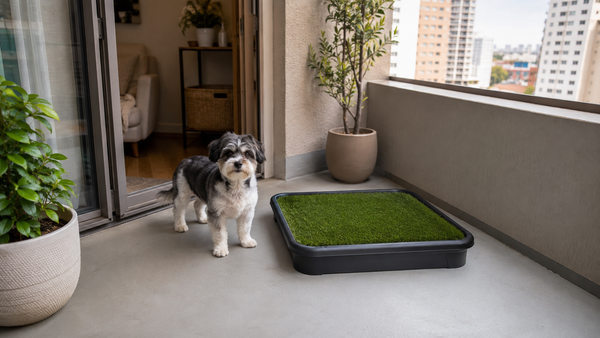
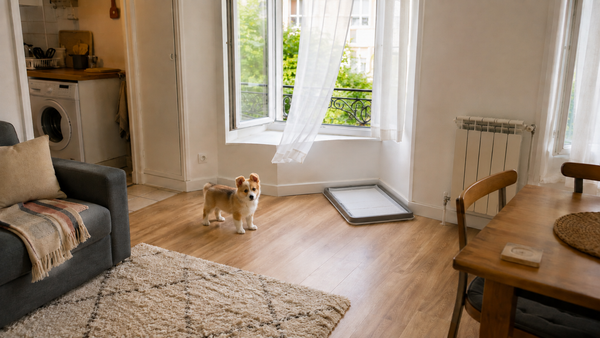
Know what you will do if the outing genuinely cannot happen. For some households that is an indoor or balcony system as a backup rather than a primary: indoor potty systems and balcony grass pads.
A building with an unreliable lift and a dog on the fourteenth floor is a real constraint, and it is worth factoring into a renewal decision rather than absorbing indefinitely.
What is a scheduling problem and what is a veterinary one
The distinction that keeps this page in its lane.
Scheduling: the routine is hard to sustain, trips are long, the lift is unreliable, the timing does not fit your work.
Veterinary: a change in frequency, straining, accidents from a previously reliable adult dog, signs of discomfort, or anything about the animal's condition. Those go to a veterinarian, and nothing on this page attempts to interpret them.
Behavioural: house-training that is not progressing, distress around being left, or accidents tied to your absence rather than to timing. Those go to a qualified trainer or a veterinary behaviourist, and who does what is set out in when the answer isn't a device: getting a trainer or a vet involved.
The wider picture of what an apartment actually demands of a dog, and what the AVMA says about it, is in keeping a dog well in an apartment.
FAQ
How many times a day does an apartment dog need to go out? Commonly published training guidance suggests around 4-5 times for adult dogs and 8-10 for young puppies, with the timing mattering as much as the count. Ask a veterinarian about your own dog, since age, health and diet all change it.
Does the elevator really make a difference? Yes, because it adds latency to every trip. Reported observation is that unpredictable delays contribute to stress and indoor accidents, which is why consistent timing matters more in a high-rise than in a house.
How do I make trips faster? Stage everything by the door so preparation is seconds rather than minutes, keep the fob attached to the leash, and know your alternative route for when the lift is out.
My dog was reliable and has started having accidents. What now? Treat that as a veterinary question rather than a scheduling one. A change in a previously reliable pattern is something to raise with a vet, and this page does not attempt to interpret it.
Is it better to add an indoor option than to do more trips? It depends on your building, your hours and your dog. An indoor or balcony system is a genuine tool with its own constraints, including where the drainage goes, and it carries a habit trade-off worth understanding before you commit.